Listfolk
If you want more fiber in your week, start with your shopping list. We looked across the store, from the produce section to the pantry shelves, and ranked these foods by the fiber in one standard serving, using USDA data. Each one meets the FDA’s bar for “high in fiber.”
How we picked
- Data
- USDA FoodData Central
- Serving
- The FDA standard serving behind the Nutrition Facts label
- “High” means
- At least 5.6 g of fiber per serving, 20% of the Daily Value
- Checked
- October 2026
-
Chia seeds
10 g fiber per 30 g, about 1 oz 34 g per 100 g · USDA
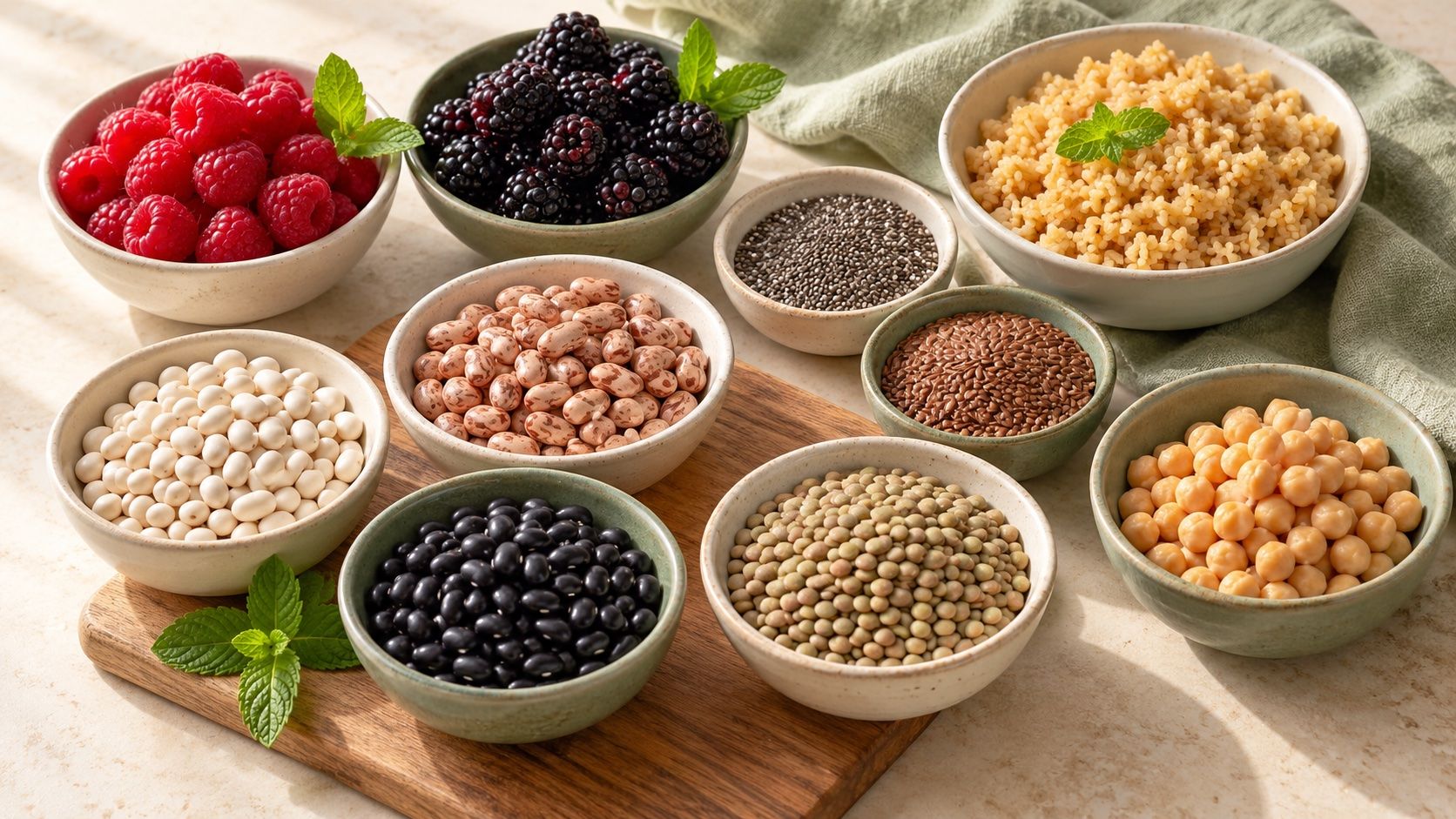
Chia seeds are tiny black or white seeds from a plant in the mint family. They’re packed with fiber, much of it in an outer layer that soaks up liquid and turns into a soft gel. That’s why a spoonful stirred into milk or yogurt thickens it within minutes. Sprinkle them over oatmeal, blend them into smoothies, or soak them overnight for chia pudding. A bag keeps for months in a cool, dark cupboard.
-
Navy beans
9 g fiber per 90 g cooked, about ½ cup 11 g per 100 g · USDA
Navy beans are small, white, mild beans, the kind used in baked beans and white bean soup. Like all dried beans, they’re seeds, and their skins and the walls of their cells are where the fiber is. They cook up soft and creamy, so they suit soups, stews and dips. Buy them dried and soak them overnight, or use canned beans and rinse them first. Cook a big pot and freeze the extras in portions.
-
Raspberries
9 g fiber per 140 g, about 1 cup 7 g per 100 g · USDA
Raspberries are soft, fragile berries made of many tiny round sections, each holding a small seed. Those seeds are a big reason raspberries have more fiber than most other fruit. They bruise easily and spoil fast, so buy them a day or two before you need them and keep them dry in the fridge. Rinse them right before you eat them, not before you store them. Frozen raspberries work just as well in smoothies, oatmeal and baking.
-
Flaxseed
8 g fiber per 30 g, about 3 tbsp 27 g per 100 g · USDA
Flaxseed is the small, glossy brown or golden seed of the flax plant. Much of each seed is fiber, held inside a hard, shiny coat. Because whole seeds are so hard, many people buy flaxseed ground, which mixes easily into oatmeal, yogurt, smoothies and baking. Ground flaxseed goes stale quickly at room temperature, so keep it in the fridge or freezer.
-
Pinto beans
8 g fiber per 90 g cooked, about ½ cup 9 g per 100 g · USDA
Pinto beans are speckled beige beans that turn an even pinkish brown when they cook. They’re the classic bean for refried beans and many chili recipes. You eat the whole bean, skin and all, so all of its fiber ends up on your plate. Mash them with a little of their cooking liquid for a quick side, or add them to burritos and rice bowls.
-
Black beans
8 g fiber per 90 g cooked, about ½ cup 9 g per 100 g · USDA
Black beans are small, shiny beans with a creamy inside and an earthy taste. As with other beans, their fiber is part of the whole seed, so there’s nothing to peel or strain away. They hold their shape when cooked, which makes them good in salads, tacos and rice bowls. Canned black beans are already cooked, so rinse them in a strainer and they’re ready to use.
-
Blackberries
7 g fiber per 140 g, about 1 cup 5 g per 100 g · USDA
Blackberries are dark, glossy berries made of many small sections, each with a tiny seed inside. Those seeds add a lot of fiber, which is why blackberries rank high among fruits. Choose berries that are deep black all over, because red ones were picked early and won’t ripen further. Eat them fresh, add them to yogurt and cereal, or bake them into a crumble. Frozen blackberries are easy to find all year and work well in cooking.
-
Lentils
7 g fiber per 90 g cooked, about ½ cup 8 g per 100 g · USDA
Lentils are small, flat seeds from the same plant family as beans, sold dried in brown, green, red and black varieties. Like beans, they’re eaten as whole seeds, which is where their fiber comes from. Unlike most dried beans, they don’t need soaking and cook fairly quickly. Brown and green lentils keep their shape for salads and side dishes, while red lentils soften into soups and curries.
-
Chickpeas
7 g fiber per 90 g cooked, about ½ cup 8 g per 100 g · USDA
Chickpeas, also called garbanzo beans, are round, beige legumes with a firm bite and a nutty taste. They’re the main ingredient in hummus and falafel. Their dense, starchy flesh and thin skin both carry fiber, and both stay in when you cook or mash them. Roast canned chickpeas until crisp for a snack, or add them to salads, curries and stews.
-
Bulgur
6 g fiber per 140 g cooked, about ¾ cup 5 g per 100 g · USDA
Bulgur is wheat that has been cooked, dried and cracked into small pieces. It’s made from the whole grain, bran included, so it keeps far more fiber than white rice or regular pasta. Fine bulgur only needs soaking in hot water, which is how it’s used in tabbouleh. Coarser bulgur simmers like rice and works in pilafs, grain salads and stuffed peppers.
Close, but under 5.6 g per serving: whole-wheat pasta (5 g per 140 g cooked), artichokes (5 g per 3 oz cooked), pears (4 g per 140 g), and rolled oats (4 g per 40 g dry).
General information, not medical or dietary advice.
Nutrient data from USDA FoodData Central, checked October 2026.